Showing posts with label Bible. Show all posts

The Return of the Fear of Comets

Comets are cyclic phenomena. We know they move in elliptical orbits; a fact discovered by Johann Baptist Cysat (1587-1657). The completion of a cycle (a period) is different among them. Some comets fade away, and some of them never return. There are comets with a period of fewer than 30 years, others may take longer than 200 years to return.

Comets do not come to visit or frighten us: the simply orbit around the Sun. They approach the center of our solar system, make a turn, and disappear into the dark Cosmos possibly to never return.

Among the familiar comets is the well-known Halley's Comet; the most recent apparition was in 1986, although very faint for the naked eye. Halley's Comet is expected to return by the year 2061.

But with every return of a comet, especially if it is expected to be a great comet, the fear for them returns.

David Berg (1919-1994) was a cult preacher that induced great fear for the Comet Kohoutek of 1986 that—according to him—was supposed to cause great disaster and to signal a colossal event.

Here are some of his warnings:
Even in modern times some people are afraid of comets.
Even today, comets are feared.
  • ACCORDING TO OUR OWN CALCULATIONS 1986 SHOULD BE ABOUT THE TIME OF THE FINAL TAKEOVER OF ONE WORLD GOVERNMENT BY A WORLD DICTATOR known in the Bible as the “Antichrist,” and the beginning of his reign of terror!
  • THE MOST BRILLIANT COMET OF THE PAST CENTURY WAS THE GREAT COMET OF 1882 which appeared and disappeared within about the same year of the deaths of two of the most influential men in all modern history, and upon whose teaching both the faith and fate of a Godless world now hangs: Charles Darwin and Karl Marx! Both sealed the doom of Churchianity and Capitalism and the end of an age, if not the world!

Read a complete article about this malevolent induced fear here.

Books About the Fourth Dimension

Image of the cover of the EBook: 'Another World or The Fourth Dimension'.
Another Word,
or The Fourth Dimension.
Now you can download many controversial books from authors out the mainstream. Open your mind to other ideas, to other fields of knowledge.

These are carefully reformatted books for easy and joyful reading, and without password restriction for printing.

Flatland is a book about a journey of a character from a two-dimensional world that visits a one-dimensional kingdom—Lineland—and that is also visited by a character from the third dimension—Spaceland.

By analogy, since we are three-dimensional, what if we make a similar journey to Flatland, and then to the fourth dimension? Right now, how can we recognize visitors from the fourth dimension?

Selected Papers of Charles Hinton About the Fourth Dimension is a collection of essays from the pen of Charles Hinton, the classic writer that initiated an effort to put an order in the chaos of the thinking about other dimensions besides our three-dimensional world.

Some passages of the Bible are interpreted as from the fourth dimension.
Some passages from the Bible
can be interpreted as from the fourth dimension.
Readings of the Fourth Dimension Simply Explained is another collection of articles, this time from different authors. Another classic in this subject, sponsored by the well-known magazine Scientific American. Many of the authors were teachers and experts in their field of knowledge.

Another World or the Fourth Dimension is a curious book about the presence of the fourth dimension in the Bible.  Is the presence of so many strange experiences narrated in the Bible evidence that the fourth dimension really exist?

The 4-D Doodler is the story of a man that is trapped between the edges of the Spaceland and the fourth dimension. Could this really happen in a future space-time travel? In 2012, or 2100, or 3500...? Is it happening now?

Download any of these books now!

The Deluge Revisited ... Once More

Noah in his Ark waiting for the Deluge.
The story of The Deluge has many interpretations.
The story of the Deluge is a narrative that is mythical for many, however historically true for millions.

The Deluge In The Light Of Modern Science, by William Denton is a critical analysis of this story as it is found in the Christian Bible.

A few extracts of his commentaries are sufficient to grasp Denton's style:
"Noah, his family, and the animals, went in seven days before this time, and left the ark the six hundred and first year of Noah’s life, the second month, and the twenty-seventh day of the month. They were therefore in the ark for one year and seventeen days.What a quantity of hay would be required, the material most easily obtained!"
"An elephant eats four hundred pounds of hay in twenty-four hours. Since there are two species of elephants, the African and the Indian, there must have been four elephants in the ark; and, supposing them to live upon hay, they would require three hundred tons."
"Many animals live upon insects; and this must have been the most difficult part of the provision to procure. There are nineteen species of goatsuckers; and there must have been in the ark two hundred and sixtysix individuals. These birds feed upon flies, moths, beetles, and other insects. What an innumerable multitude must have been provided for the goatsuckers alone! But there are a hundred and thirty-seven species of fly-catchers; and Noah must have had a fly-catcher family of nineteen hundred and eighteen individuals to supply with appropriate food. There are thirty-seven species of bee-eaters; and there must have been five hundred and eighteen of these birds to supply with bees. A very large apiary would be required to supply their needs."

The cover page of the EBook The Deluge In The Light Of Modern Science.
The Deluge In The Light Of Modern Science.
Denton concentrates his analysis of the narrative of the Deluge on the many difficulties Noah had when collecting the animals for his Ark:
"How could the ostriches of Africa, the emus of Australia, and the rheas of South America, get there,–birds that never fly? There are three species of the rhea, or South-American ostrich; and forty-two of these would have a journey of eight thousand miles before them, by the shortest route: but how could they cross the Atlantic?"
However, some questions arise concerning all the water that fell during all those forty days of heavy continuous rain:
"It is as great a difficulty to discover where the water went when the flood was over. We are told that the fountains of the deep and the windows of heaven were stopped, and the rain was restrained. But this could do nothing towards diminishing the water".

What Is the Shape of a Wheel in the Fourth Dimension?

In 1909, the renowned magazine Scientific American held a contest where authors were called to submit articles answering the question "What is the fourth dimension?" The magazine received more than two hundreds essays, a respectable quantity for such an obtuse subject at that time.

The judge in charge to select the best articles was Dr. Henry Parker Manning (1859-1956), a mathematics professor at Brown University. Manning was a specialist in non-traditional geometries and algebras like non-Euclidean geometry and quaternions.

One of the rules of the contest was that the articles should not be greater than 2500 words; thus the essays were going be medium sized in length. Another rule was that the essays should be submitted with pseudonyms instead of the true author name. Since each author was writing independently of the others, and from different countries, some repetitions in concepts were inevitable.
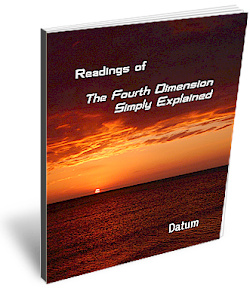
Readings of "The Fourth Dimension Simply Explained".
Readings of The Fourth
Dimension Simply Explained
Out of the large amount of essays, Dr. Manning edited a book of what he considered the best 22 articles, and wrote an Introduction for them where he exposed his view of some of the articles selected, and even corrected some misconceptions about transformations and manipulations of objects in the fourth dimensions, like turning gloves inside-out. The book was published under the title: The Fourth Dimension Simply Explained.

Reproduced below is the discussion of Manning about what should be a wheel in four-dimensional space.
A wheel of four-dimensional matter, in two dimensions of the shape of a circle and in the other two dimensions very small, would have for axis a flat plate instead of a rod. This axial plate could extend indefinitely in all the directions of its plane without any interference with the wheel. The wheel can slip all around over the axial plate unless held to some position on it, just as with us a wheel may slip along on its axis unless held to some position on it. We may suppose that in a three-space we can see the axial plate and a pair of opposite radii (spokes) of the wheel, appearing to us entirely separate; in this way we can see a two-dimensional hole. Or we can see the entire wheel with a hole through it and an axial rod, cut from the axial plate by our three-space.
Manning included no figures to clarify his ideas, but we can suppose that what he did is that in the same way that a line (an axis) projected into the next dimension would produce a plane, he deduced that an axis holding two wheels, when projected into the next dimension would become a plane. It is not easy to visualize two linked rotating wheels in 4D where their common axis is a plane, but anything about the fourth dimension is not easy.

But Manning goes further and writes:
We can fasten the wheel rigidly to the axial plate so that it will turn with the wheel, the wheel turning in its plane and the plate turning on itself. We may put more than one wheel on an axial plate, putting different wheels at different points on the plate wherever we please. If these wheels are all fastened rigidly to the axial plate we turn them all by turning one. Thus we have a method of constructing machinery in space of four dimensions.
If this is not enough to dazzle your mind, wait until you read this:
The axial plate may itself be a wheel. We may fasten two wheels together at their centers making them absolutely perpendicular to each other. Such a figure can revolve in two ways, the plane of one wheel being the axis plane of the rotation and the plane of the other wheel the rotation plane.
Dr. Manning should be speaking from a strictly mathematical point of view; he cannot be fantasizing about higher dimensions. However in the past article The strange extraterrestrial worlds of Camille Flammarion, in the paragraphs about the controvertible Flammarion's woodcut, I called to the attention to the enigmatic solid wheel that appears at the top of the "woodcut" (the woodcut figure is repeated here). Note how in this woodcut, the two intersecting wheels are drawn like two classic ox cart wheels. Possibly, when the artist carved this --let's call it, cross-wheel, or super-wheel-- he was not thinking about a fourth dimension, he needed not to. What he tried to convey was the idea that beyond the spheres that limit our imagination many things can coexist even when they appeared to be contradictory to our senses. Hence, for this artist, wheels that can move in two directions simultaneously are possible. Manning, speaking without the need to recur to metaphors tells us that this is possible; in a 4-dimensional world.

Adding to his exposition of a 4D-wheel, Manning says:

We might have a spherical wheel; something in three dimensions of the shape of a sphere and its fourth dimension very small. Such a wheel with a one-dimensional hole through it may turn on an axial rod, but its motion is not confined to a definite direction of rotation as is the case with the flat wheel turning in its plane.
An old print depicting the Ezekiel's enigmatic wheels.
 Ezekiel's enigmatic impossible wheels.
Flammarion's woodcut is not the only picture that incorporates a possible 4D-wheel. See that in the next picture there is also the same 4D-wheel element incorporated as part of Ezekiel's vision. In fact, the origin of this idea or metaphor comes from the following verses (Chapter 1 of Ezekiel 15-18 ) of the book of Ezekiel in the Bible:
"As I looked at the living creatures, I saw a wheel on the ground beside each creature with its four faces. This was the appearance and structure of the wheels: They sparkled like topaz, and all four looked alike. Each appeared to be made like a wheel intersecting a wheel. As they moved, they would go in any one of the four directions the creatures faced; the wheels did not change direction as the creatures went. Their rims were high and awesome, and all four rims were full of eyes all around."
Continuing with Manning's Introduction see the following"
A spherical wheel may be used for vehicles. If four dimensional beings lived on a four-dimensional earth; that is, alongside of its three-dimensional boundary, a vehicle with four or more wheels of either kind could be used in traveling over this earth. With a flat wheel he could travel only in a straight line without friction between the wheel and the earth; with a spherical wheel he could travel in any direction in a plane without such friction, but would meet with a slight friction in turning from one plane to another.

Download the free ebook: Readings of The Fourth Dimension Simply Explained.

We have discussed so far the Introduction that Dr. Henry P. Manning wrote to the book The Fourth Dimension Simply Explained. The edition that Datum is giving for free contains many essays about the fourth dimension that you will surely enjoy. Download it now!