Showing posts with label fourth dimension. Show all posts

The Fourth Dimension According to Charles Hinton

Surely at some time of your life, you have heard about traveling to the fourth dimension. The are many books—famous books—and many movies—famous movies—around this topic. This means that the topic is of interest to everybody, and not only for a selected group of mathematicians and physicists.

When people are confronted with the subject of higher dimensions, or when asked if they believe in it or not, their answer will vary depending on if their background is more religious than scientific or vice versa.

The fact is that for many people "the fourth dimension" is a place—similar and different to our surrounding three-dimensional world around us. Visualizing it as "place" enable us to enter or exit from it like when going to some kind of theme park. Going to such a place will enlighten and will empower us in such a way that from that experience on to forever we'll be talking about the experience like sacred events that should not be shared with anybody except those "chosen" to experience a trip like ours in the future.

For the privileged beings of this hyperworld, we are seen somewhat as toys that can be manipulated at their will.

In the literature arena of the books, Charles Hinton (1853 - 1907), a British mathematician, occupies the place of one of the initiators among the public the fourth dimension subject. He studied the topic in a reasonable systematic approach, recurring to simple examples and explaining his ideas in nonmathematical terms.

Selected Papers of Charles Hinton
about the fourth dimension
The Selected Papers of Charles Hinton about the fourth dimension is a good compilation of many of his works in a simple nonmathematical language.


Hermann Schubert Probes the Fourth Dimension

Mathematical Essays and Recreations
Hermann Schubert was a German teacher and textbook author. Mathematical Essays and Recreations is a small collection of articles ranging from the foundations of the number system, the foundations of algebra up to an extensive essay about the fourth dimension.

In the first article: Notion and definition of number, Shubert gives a brief account of how the concept of number evolved within the human mind.

In another of his essays: Monism in arithmetic, the author explores and writes about the elementary rules of algebra and about the importance that mathematical systems can operate with defined rules for any kind of number without making exceptions for some of them. For example, we can define the commutative rule of addition for the natural numbers, as in 2 + 3 = 3 + 2, and the same number should apply if instead, we use natural an imaginary numbers combined, like 2 + 3i = 3i + 2. Following his exposition, we can easily see why the class of complex numbers is such a robust field in mathematics, and how it can be derived from the natural numbers following easy and consistent steps. On the other hand, we can also see why the quaternions—when compared to the complex numbers—lack such popularity and why this class of number is so limited in applications and acceptance.

The third essay in this Datum edition is about the fourth dimension. But contrary to other science authors that rarely touch the fourth dimension from the metaphysical point of view, Schubert is not afraid to confront both doctrines. When dealing with the fourth dimension from the mathematical point of view, Schubert goes carefully from the definition of the point to the definition of dimension to a many-dimensioned space.

Are There Coordinates for the Fourth Dimension?

The interest in the fourth dimension is ever increasing. We all keep asking: Can there really exist a fourth dimension? In what direction should we look to find it? Why there are so many interpretations of it?

Is the spiritual fourth dimension the same as the physicists' interpretation? What is doing the mathematics about it?

Image of a simple four-legged table.
The legs of a table do not have
any naming order. 
Well, to begin with, we all agree that WE ALL LIVE in three dimensions. That's a good start, but we do not all agree which one is THE FIRST DIMENSION. We don't know which dimension is the SECOND DIMENSION; so, how can we all agree which dimension should be the FOURTH DIMENSION?

To study the fourth dimension from the geometrical or algebraic standpoint of view we should associate dimensions with coordinates in a spatial hyperspace. This approach leads us to ask: Are there coordinates for the fourth dimension?

In the article, The Coordinates of the Fourth Dimension, I use the figure of a little dining table to ask which one of the four legs of the table we should say is THE FIRST LEG, which one of the four legs is the FOURTH LEG.

Take the challenge, read the article,  and be the first one to answer the question and fill in the blanks: In any table, the first leg is determined by ...!

Books About the Fourth Dimension

Image of the cover of the EBook: 'Another World or The Fourth Dimension'.
Another Word,
or The Fourth Dimension.
Now you can download many controversial books from authors out the mainstream. Open your mind to other ideas, to other fields of knowledge.

These are carefully reformatted books for easy and joyful reading, and without password restriction for printing.

Flatland is a book about a journey of a character from a two-dimensional world that visits a one-dimensional kingdom—Lineland—and that is also visited by a character from the third dimension—Spaceland.

By analogy, since we are three-dimensional, what if we make a similar journey to Flatland, and then to the fourth dimension? Right now, how can we recognize visitors from the fourth dimension?

Selected Papers of Charles Hinton About the Fourth Dimension is a collection of essays from the pen of Charles Hinton, the classic writer that initiated an effort to put an order in the chaos of the thinking about other dimensions besides our three-dimensional world.

Some passages of the Bible are interpreted as from the fourth dimension.
Some passages from the Bible
can be interpreted as from the fourth dimension.
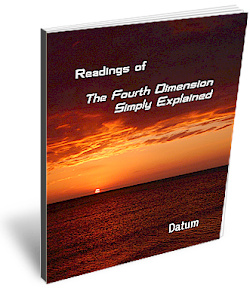
Readings of the Fourth Dimension Simply Explained is another collection of articles, this time from different authors. Another classic in this subject, sponsored by the well-known magazine Scientific American. Many of the authors were teachers and experts in their field of knowledge.

Another World or the Fourth Dimension is a curious book about the presence of the fourth dimension in the Bible.  Is the presence of so many strange experiences narrated in the Bible evidence that the fourth dimension really exist?

The 4-D Doodler is the story of a man that is trapped between the edges of the Spaceland and the fourth dimension. Could this really happen in a future space-time travel? In 2012, or 2100, or 3500...? Is it happening now?

Download any of these books now!

Is the Book of Sand a Book from the Fourth Dimension?

The Book of Sand is a short story
by Jorge Luis Borges.
This is the fourth article in the series about the popular short story The Book of Sand of Jorge Luis Borges.

I finished the previous article with the following paragraph:
"Despite of this book being infinite, as Borges admits (and transfinite—according to my interpretation) he also suggests that it can be equally finite. Is this possible?"
The goal of the current article is to show that the book Borges bought from a Bible salesman was a mysterious object that was more than infinite in content: it was also a multidimensional and extra-real object, a supernatural book that was capable of existing in several dimensions, and being finite and infinite at the same time.

The Book of Sand is a hyperbook

What are some of the hints that Borges give us that point toward the book extending to other dimensions beyond our 3-dimensioned space? There are two:
  • At the beginning of the story, Borges mentions his initial intention of starting his story as a geometrical plot. We see this in the very first paragraph where he writes: "The line is made up of an infinite number of points, ... , the hypervolume of an infinite number of volumes". And then proceeds "No, unquestionably this is not—more geometrico—the best way of beginning my story". With this brief introduction he follows the geometrical tradition of Charles Hinton (1853 - 1907) with his books and essays about the fourth dimension like What is the Fourth Dimension, and Scientific Romances, and Edwin Abbott Abbott (1838 - 1926) with his Flatland: a Romance of Many Dimensions —a journey to the 1 and 2-dimensional space and a journey to the fourth dimension. Borges, like them, constructs the dimensioned space as a series or set of infinite points, planes, and volumes, but nowhere else in the story, he makes a reference again to the concept of dimensionality. However, and in analogy with those concepts, we will shortly see that he implicitly assumes that a hyperbook can be made up of infinitely many books.
But, what is a hyperbook? Let us first review what is hypercube. Similarly to the line, the plane, and the cube, a hypercube is a cube that is the result of moving or dragging our ordinary cube to the 4th-dimension. But where is the fourth dimension? Although difficult to imagine, the fourth dimension is supposed to be "perpendicular" to our ordinary three dimensions. We (as Borges) arrive at this conclusion by simple induction: the plane is generated by moving a straight line perpendicularly to its length; a solid is obtained by moving a plane perpendicular to its surface. Note that in each case the motion is perpendicular to the dimensions of the previous object.

The hypercube is similarly obtained: by moving a cube perpendicular to the three dimensions it has. Visualizing the hypercube is not an easy task because we cannot imagine where is a dimension that is perpendicular to our daily 3-dimensional world. Note that according to the previous assumptions a plane is a "hyperline", and a cube is a "hyperplane". Furthermore, even a cube can be considered as a "hyper-hyperline", but since this concept is little more than meaningless, we can plainly say that the cube is also a "hyperline".

Returning to our hyperbook, let us simplify the shape of the book assuming that it is like a cube (a book can be cubical). Then, a hyperbook is a 4-dimensioned book such that any reduction of its 4-hyperspace to a 3-dimensioned space results in an ordinary book.

Mathematicians not only speak of hyperspaces and hypercubes but also of hyperspheres, so Borges —who was also related with modern mathematics— simply extended this concept to the books: if mathematicians could conceptualize such hyper-objects, for him was also very easy to conceptualize the hyperbooks.

Attributing to Borges the idea that The Book of Sand is a hyperbook —and not a simple solid— is not a sound reasoning if we cling to the above arguments alone. But there is another passage in his story that reinforces my argument that for him The Book of Sand is not a "mere" infinite book: it is also a book from other dimensions.

Let's quote again the passages to where I'll make reference:
I turned the leaf; it was numbered with eight digits. It also bore a small illustration, like the kind used in dictionaries —an anchor drawn with pen and ink, as if by a schoolboy's clumsy hand.
It was at this point that the stranger said. "Look at the illustration closely. You will never see it again."
Borges noted the place and closed the book, but once he reopened it he never found again the illustration of the anchor.

However, later he found another illustration: a mask. But there was a curiosity among them and he explicitly narrates it for us:
The small illustrations, I verified, came two thousand pages apart.
A book with illustrations every 2000 pages? Take notice that he is not saying that the next illustration is so far: he is saying that all illustrations are so far apart. He is not explicitly referring to those two illustrations, the anchor and the mask; so we can safely assume that he is writing about all the figures of the book.
Isn't this crazy? He says he verified this fact of the illustrations separation, but what type of book of has this particularity? Why exactly 2000 pages apart?

Borges used an alphabetical notebook to record the pictures he found:
I set about listing them alphabetically in a notebook, which I was not long in filling up.
The book was somehow full of illustrations because —as he says — it didn't take him too much time to fill the notebook, despite "Never once was an illustration repeated".

The Book of Sand is a dictionary

Remember the quote: "... a small illustration, like the kind used in dictionaries"? From this quote we obtain the second hint: The Book of Sand is a dictionary! This marvelous book —this hyperbook— is a dictionary because:
  • It never repeats an illustration: every instance of a "book of sand" is just a definition of an object! This is what dictionaries do: they show a single small plate or diagram and then a short or long explanation of what is this object. Every time the book is reopened, a new random definition with its corresponding pictogram appears.
  • Only a single picture per book "instance" appears. Every time he opened the book the whole book is dedicated to the description of the picture he found. Sadly, he didn't understand the accompanying definition and prose because "The script was strange to me".
The dictionary was unreadable for Borges because it was written in a foreign language or dialect: "It seems to be a version of the Scriptures in some Indian language, is it not?" he asked the salesman, but the answer was "No ... I acquired the book in a town out on the plain in exchange for a handful of rupees and a Bible. Its owner did not know how to read. I suspect that he saw the Book of Books as a talisman".

The Book of Sand is a dictionary: what a surprise! No wonder the figures were 2000 pages apart; each picture definition was 2000 pages long so that each "copy" or "instance" of the Book of Sand is dedicated to one particular object or thing. Now we understand why the figures were never repeated: because each "book of sand" consisted of a 2000-page long definition.

Can there be books from other dimensions?
The Book of Sand can be interpreted
as book from higher dimensions.
The Book of Sand as an object of parallel universes

Is the possibility of multiple instances of the same object in multiple dimensions coexisting together an insane idea? Not at all, because with the triumph of the modern physics the concept of multiverses is just one of the many hard ideas to digest.

But, how and why so many "instances" could occupy the same time-space in such a manner that the book could be held in Borges' hands? The answer is simple: remember that a hypercube is a cube surrounded by cubes in every possible dimension; therefore, in a similar manner, The Book of Sand is a hyper-dictionary surrounded by dictionaries in every possible dimension. In this way, every time Borges opened the book he was opening a dictionary in other dimensions. This is the reason why he could hold a multidimensional infinite dictionary in his hands: he was holding only a 3-dimensional instance of and infinite-dimensional dictionary. All other "copies" or chapters, or "definitions" or "instances" were in very near dimensions: just touching the "real" one, but inaccessible at the same time, as the figure at right shows.

The notion of parallel universes is not more insane than the notion of a single an unique universe; both extremes are hard to understand. I leave the reader with two simple questions related with the parallel universes idea: What law of physics states that there should be a unique 3-dimensioned space? What law of physics states that there cannot exist more than three dimensions?

What Is the Shape of a Wheel in the Fourth Dimension?

In 1909, the renowned magazine Scientific American held a contest where authors were called to submit articles answering the question "What is the fourth dimension?" The magazine received more than two hundreds essays, a respectable quantity for such an obtuse subject at that time.

The judge in charge to select the best articles was Dr. Henry Parker Manning (1859-1956), a mathematics professor at Brown University. Manning was a specialist in non-traditional geometries and algebras like non-Euclidean geometry and quaternions.

One of the rules of the contest was that the articles should not be greater than 2500 words; thus the essays were going be medium sized in length. Another rule was that the essays should be submitted with pseudonyms instead of the true author name. Since each author was writing independently of the others, and from different countries, some repetitions in concepts were inevitable.
Readings of "The Fourth Dimension Simply Explained".
Readings of The Fourth
Dimension Simply Explained
Out of the large amount of essays, Dr. Manning edited a book of what he considered the best 22 articles, and wrote an Introduction for them where he exposed his view of some of the articles selected, and even corrected some misconceptions about transformations and manipulations of objects in the fourth dimensions, like turning gloves inside-out. The book was published under the title: The Fourth Dimension Simply Explained.

Reproduced below is the discussion of Manning about what should be a wheel in four-dimensional space.
A wheel of four-dimensional matter, in two dimensions of the shape of a circle and in the other two dimensions very small, would have for axis a flat plate instead of a rod. This axial plate could extend indefinitely in all the directions of its plane without any interference with the wheel. The wheel can slip all around over the axial plate unless held to some position on it, just as with us a wheel may slip along on its axis unless held to some position on it. We may suppose that in a three-space we can see the axial plate and a pair of opposite radii (spokes) of the wheel, appearing to us entirely separate; in this way we can see a two-dimensional hole. Or we can see the entire wheel with a hole through it and an axial rod, cut from the axial plate by our three-space.
Manning included no figures to clarify his ideas, but we can suppose that what he did is that in the same way that a line (an axis) projected into the next dimension would produce a plane, he deduced that an axis holding two wheels, when projected into the next dimension would become a plane. It is not easy to visualize two linked rotating wheels in 4D where their common axis is a plane, but anything about the fourth dimension is not easy.

But Manning goes further and writes:
We can fasten the wheel rigidly to the axial plate so that it will turn with the wheel, the wheel turning in its plane and the plate turning on itself. We may put more than one wheel on an axial plate, putting different wheels at different points on the plate wherever we please. If these wheels are all fastened rigidly to the axial plate we turn them all by turning one. Thus we have a method of constructing machinery in space of four dimensions.
If this is not enough to dazzle your mind, wait until you read this:
The axial plate may itself be a wheel. We may fasten two wheels together at their centers making them absolutely perpendicular to each other. Such a figure can revolve in two ways, the plane of one wheel being the axis plane of the rotation and the plane of the other wheel the rotation plane.
Dr. Manning should be speaking from a strictly mathematical point of view; he cannot be fantasizing about higher dimensions. However in the past article The strange extraterrestrial worlds of Camille Flammarion, in the paragraphs about the controvertible Flammarion's woodcut, I called to the attention to the enigmatic solid wheel that appears at the top of the "woodcut" (the woodcut figure is repeated here). Note how in this woodcut, the two intersecting wheels are drawn like two classic ox cart wheels. Possibly, when the artist carved this --let's call it, cross-wheel, or super-wheel-- he was not thinking about a fourth dimension, he needed not to. What he tried to convey was the idea that beyond the spheres that limit our imagination many things can coexist even when they appeared to be contradictory to our senses. Hence, for this artist, wheels that can move in two directions simultaneously are possible. Manning, speaking without the need to recur to metaphors tells us that this is possible; in a 4-dimensional world.

Adding to his exposition of a 4D-wheel, Manning says:

We might have a spherical wheel; something in three dimensions of the shape of a sphere and its fourth dimension very small. Such a wheel with a one-dimensional hole through it may turn on an axial rod, but its motion is not confined to a definite direction of rotation as is the case with the flat wheel turning in its plane.
An old print depicting the Ezekiel's enigmatic wheels.
 Ezekiel's enigmatic impossible wheels.
Flammarion's woodcut is not the only picture that incorporates a possible 4D-wheel. See that in the next picture there is also the same 4D-wheel element incorporated as part of Ezekiel's vision. In fact, the origin of this idea or metaphor comes from the following verses (Chapter 1 of Ezekiel 15-18 ) of the book of Ezekiel in the Bible:
"As I looked at the living creatures, I saw a wheel on the ground beside each creature with its four faces. This was the appearance and structure of the wheels: They sparkled like topaz, and all four looked alike. Each appeared to be made like a wheel intersecting a wheel. As they moved, they would go in any one of the four directions the creatures faced; the wheels did not change direction as the creatures went. Their rims were high and awesome, and all four rims were full of eyes all around."
Continuing with Manning's Introduction see the following"
A spherical wheel may be used for vehicles. If four dimensional beings lived on a four-dimensional earth; that is, alongside of its three-dimensional boundary, a vehicle with four or more wheels of either kind could be used in traveling over this earth. With a flat wheel he could travel only in a straight line without friction between the wheel and the earth; with a spherical wheel he could travel in any direction in a plane without such friction, but would meet with a slight friction in turning from one plane to another.

Download the free ebook: Readings of The Fourth Dimension Simply Explained.

We have discussed so far the Introduction that Dr. Henry P. Manning wrote to the book The Fourth Dimension Simply Explained. The edition that Datum is giving for free contains many essays about the fourth dimension that you will surely enjoy. Download it now!