Showing posts with label myths. Show all posts

The Myth of the Hollow Earth: Some Myths Never Die

Yes, we see it every day; some myths never die.

Image of a gargoyle.
A gargoyle.
People need to believe in something. We need fairies, unicorns, angels, demons, mermaids, dragons, goddesses, winged horses, gargoyles, etc.

The same thing happens in science: no matter the advances in astronomy people keep searching and reading their daily horoscope. If this makes them self-assured and happy, its OK. Why destroy their illusions? Maybe myths are an inherent need deep within us.

However, the myth of the hollow Earth is another type of myth, because it is a showdown, a confrontation between physics and traditional beliefs. But physics, or geography, or geology do not work this way. Solid hypotheses and experimentation to confirm the experiments are needed.


There are many variations of the hollow Earth idea:
Image of William Reed's concept of the hollow earth.
Some people still think that the Earth is hollow.
  • The Edmund Halley's idea that the Earth's inside is made up of concentric hollow spheres and four poles. For Halley, the spheres' diameters are in proportion to some planet orbits.
  • The Cleves Symmes's idea that the Earth is made up of concentric—not as Halley postulated-- but with a strong will to go himself into the Earth's core.
  • The Cyrus Reed Teed's concept that the Universe was inside the Earth's crust cradled 'in the hands of God."
  • The William Reed dream-concept that the Earth's interior is warm and with volcanoes as in the outside.
But believe it or not, some of those ideas still survive. Some people are making plans to travel to the North Pole to take a look at the entrance to the interior of the Earth.
    See the complete article and more in: What do you know about the hollow Earth and the hollow Moon?

    The 10 Top Myths About the Infinite

    Myth 1: An infinite split by one half is no longer infinite
    Let's us take the set of all natural numbers, i.e., the numbers we use to count, like 1, 2, 3, ... We will represent this set by the symbol Z. Each one of the natural numbers is either odd or even; the odd numbers being 1, 3, 5, ... and the even numbers 2, 4, 6, ... Note that the numbers we call even are those divisible by 2. Hence every natural number is either divisible by two or not. Those that are not divisible by 2 are the odd numbers.

    Natural numbers = odd numbers + even number

    Z = {1, 2, 3, 4, 5, 6, 7, ...} = {1, 3, 5, ...} + {2, 4, 6, ...}
    The even numbers are infinite because there is no end to this series. Same with the set of odd numbers: there is no way to find and end to this series. So the infinite set of all natural numbers is the sum of two infinite series; the series of the odd numbers plus the set of the even numbers.
    If you take away the infinite set of the even numbers from the infinite set of the natural numbers you are left with an infinitude of odd numbers.

    {1, 3, 5, ...} = {1, 2, 3, 4, 5, 6, 7, ...} - {2, 4, 6, ...}

    To a similar behavior we are faced if we take away the set of the odd numbers from the set Z.

    Therefore, it is not necessarily true that if we split an infinitude in a half, the two parts are no longer infinite.

    Myth 2: One infinite added to another infinite is a greater infinite
    This one is the opposite of the above myth.

    Myth 3: If we increasingly take away infinite elements from an infinite set, eventually, the remaining set is no longer infinite

    This is not the same as Myth 1: there we were linearly taking away one integer for each one left.

    Suppose that to the set of all natural numbers Z we remove numbers from it using this pattern:
    1. Leave the number 1, but take away the next 2. We are left with {1, 4, 5, 6, ...}
    2. Leave the number 4, but take away the next 5. We are left with {1, 4, 10, 11, ...}
    3. Leave the number 10, but take away the next 11. We are left with {1, 4, 10, 22, ...}
    4. Repeat the pattern over and over again.
    Note that with each step we are taking more an more elements away from the original set of the natural numbers. The separation between the remaining integers is wider and wider. If we repeat this process indefinitely, we'll be progressively removing more an more elements. This is far from the first example above where we were removing even or odd numbers only, because in this schema we are removing from both types of numbers.

    However, no matter how far we go or how many integers we remove, the remaining set will be always infinite because although the steps are infinite, the elements to be removed are always finite.
    Myth 4: There are more fractions than natural numbers
    This assertion might appear to be against our intuition because we assume that since every natural number can be expressed as a fraction, like

    1 = 1/1,
    2= 2/1 = 2/2,
    3 = 3/1 = 6/2 = 9/3 ...
    we can conclude that there are more ways of expressing fractions than the numbers themselves. However, note that in the pyramidal scheme above, we can count the fractions as follows:
    1/1 = is the first
    2/1 = is the second, 2/2 is the third
    3/1 = is the fourth, 6/2 is the fifth, 9/3 is the sixth,

    Hence, no integral fraction can escape our counting scheme. Therefore, the integral fractions are countable which means that there are not more integral fractions than natural numbers.
    Myth 5: An infinitude of elements multiplied by another infinitude is always a grater infinitude

    Myth 6: Since every fraction can be converted to a decimal then there are as my decimals as fractions

    Myth 7: The segment of the line from 0 to 1 contains double the points as the segment from 0 to 1/2

    Myth 8: The number of grains of sand is infinite.
    This is a classic myth. Probably all of us, at some stage of our live, had think that the grains of sands are infinite.

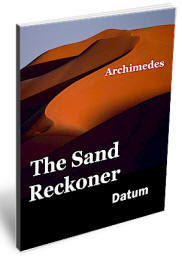
    Cover page of the EBook: The Sand Reckoner, by Archimedes.Archimedes is the first documented one to tackle down the needed mathematics to show that it is impossible the for the sand to be infinite. Strictly speaking, what he showed was that we can count how many grains can a universe hold, no matter how big it is.
    At his time the observable universe was up to Saturn, so what he did was to compute how many grains can fill a sphere the size of the orbit of Saturn. The mathematics needed to arrive at his conclusion were simple, but ingenuous extensions he devised for the arithmetic of his time was an enormous contribution.
    You can download his all-time famous book The Sand Reckoner here.

    Myth 9: If a vase is infinitely long, then it must have an infinite capacity

    This is a beautiful one ...

    Gabriel's Horn


    Myth 10: If there were infinite universes out there, in some of them, or at least in one, should be an exact copy of our planet Earth